
Press Release
Published July 7,2026
Strong Heat Sealing of OPP Films Simply by “Keeping the Heat In”
~Controlling heat dissipation with the porous structure of washi paper toward recyclable mono-material packaging~
【Background】 Plastic films are indispensable materials in modern society, providing safe and hygienic packaging for food, pharmaceuticals, daily necessities, and many other products. While reducing plastic consumption and replacing conventional plastics with biodegradable alternatives are increasingly being explored, another important challenge is how to use currently available plastics more efficiently, with less material and energy, while making them easier to recycle after use. Biaxially oriented polypropylene (OPP) film is widely used in packaging because of its excellent transparency, stiffness, moisture resistance, and other desirable properties. However, the polymer chains in OPP films are highly oriented during the stretching process used in film production, making direct heat sealing of OPP films inherently difficult. For this reason, conventional packaging often uses multilayer structures in which OPP is combined with sealant layers such as cast polypropylene (CPP) or polyethylene, which melt at relatively low temperatures. However, combining different materials and adhesives can make recycling more difficult. Therefore, the development of mono-material packaging, in which packaging structures are composed as much as possible of the same type of polymer, has become an important goal.
Instead of increasing the temperature, “keep the heat in”
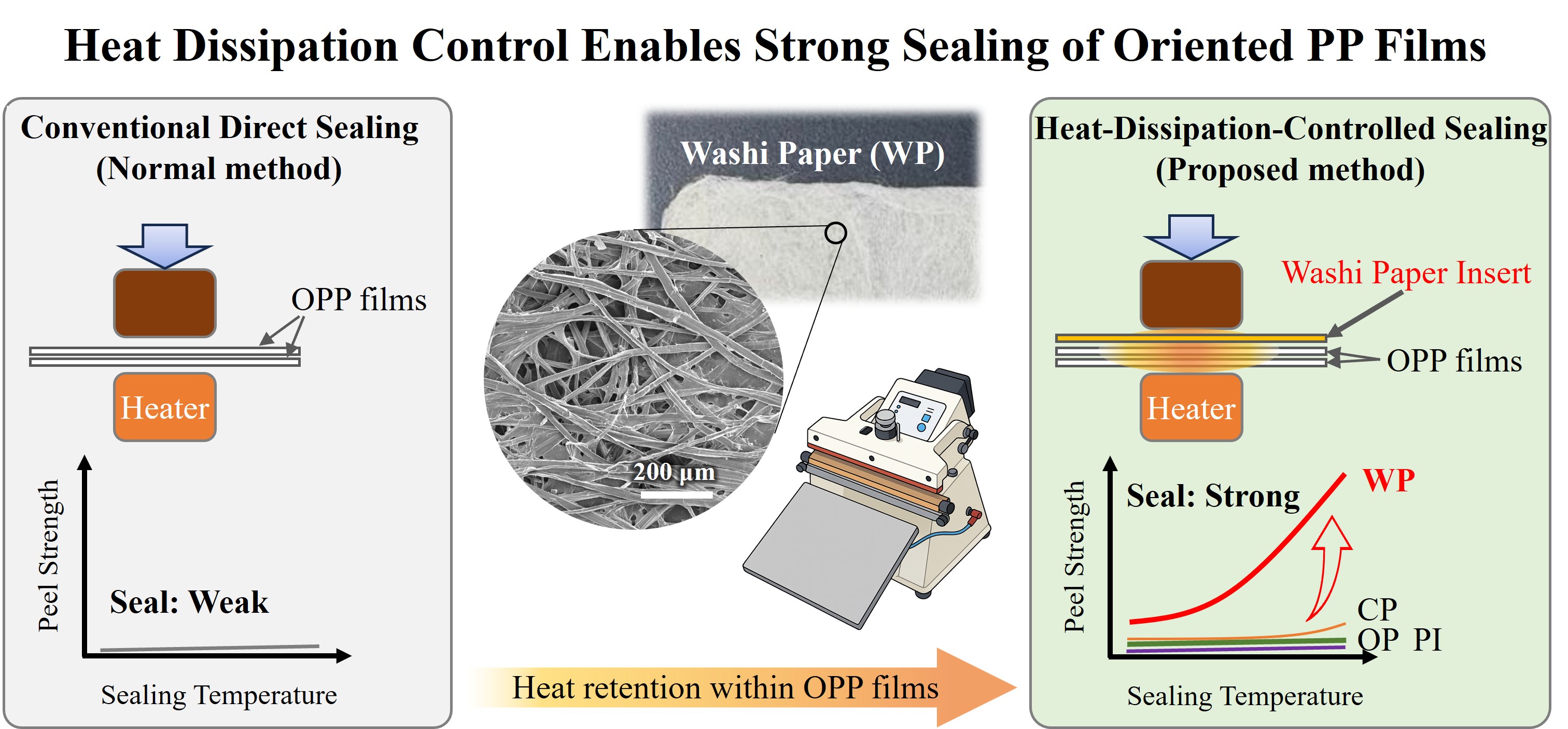
Simply increasing the heating temperature to directly seal OPP films not only increases energy consumption but can also cause film shrinkage, deformation, wrinkling, and deterioration of mechanical properties. In this study, we therefore focused on a different concept: rather than “applying more heat,” we sought to “prevent the applied heat from escaping.” Using a commercially available impulse sealer, a single sheet of washi paper approximately 110 µm thick was inserted between two stacked OPP films and the silicone-rubber receiving bar. Importantly, the washi paper was not placed between the two OPP films at the sealing interface. Instead, it was placed outside the films, between the OPP film and the receiving bar, to suppress heat dissipation toward the receiving-bar side. With conventional sealing and with OPP or polyimide films used as inserted sheets, the peel strength remained approximately 0.5 N/15 mm or less even at 155 °C. In contrast, inserting washi paper increased the peel strength to approximately 6 N/15 mm at 150 °C and to more than 8 N/15 mm at 155 °C. At temperatures of 150 °C and above, the seal became so strong that the OPP film itself tore rather than separating at the sealed interface.
Why does washi paper enable such strong sealing?
Scanning electron microscopy revealed that the kozo-based washi paper used in this study consisted of relatively thick, long fibers forming a highly porous network with numerous inter-fiber voids, in marked contrast to the denser structure of conventional copier paper. This air-rich porous structure is considered to act as a thermal barrier, suppressing heat dissipation toward the receiving bar during impulse sealing. To verify this effect, an ultrathin thermocouple with a thickness of only 20 µm was placed directly between the two OPP films, and the sealing-interface temperature was measured at intervals of 10 ms. Among all the conditions examined, the highest interfacial temperature was obtained when washi paper was used. These results demonstrate that even at the same heater setting, controlling heat dissipation enables the supplied thermal energy to be used more effectively within the films.
Molecular structure changes throughout the film thickness
Structural changes within the OPP films were further investigated using polarized-light observation, differential scanning calorimetry (DSC), ATR-FTIR spectroscopy, and micro-Raman spectroscopy. In particular, cross-sectional micro-Raman mapping showed that under conventional sealing conditions, changes in molecular orientation were mainly confined to the region near the heater-contact surface. In contrast, when washi paper was inserted, molecular orientation relaxation extended throughout the entire 40 µm thickness of the OPP film. Taken together, these results indicate that suppression of heat dissipation by the washi insert promoted molecular orientation relaxation, partial melting, and subsequent recrystallization during cooling. These structural rearrangements occurred throughout the film thickness and ultimately enabled the formation of a strong seal between the OPP films.
Not simply “eliminating” plastics, but “using them more efficiently”
Plastic packaging remains essential for safely and hygienically protecting food, pharmaceuticals, and many other products. At the same time, multilayer packaging composed of different materials can be difficult to recycle, while the energy consumed during packaging and sealing processes is another important consideration. Our approach does not require chemical modification of the OPP film itself, nor does it introduce additional adhesives or sealant layers. Instead, this study demonstrates that controlling how heat dissipates in an existing heat-sealing system can enable strong direct sealing between oriented OPP films that are otherwise difficult to seal. The significance of this study is therefore not limited to the use of washi paper itself in industrial sealing equipment. More importantly, it demonstrates that the supplied thermal energy can be used more effectively by designing the heat-transfer and thermal-insulation characteristics of the receiving side of the sealing system. Further optimization of receiving-bar materials and thermal-insulation structures may enable sufficient seal strength to be achieved at lower heater settings or with shorter sealing times. Extending this concept to other oriented polyolefin films may ultimately contribute to technologies that combine recyclable mono-material packaging with more energy-efficient packaging and sealing processes.
【Publication】
"Heat dissipation control enables strong sealing of oriented polypropylene films using a washi paper insert", Linmei Zhang,Haruhiro Ino, Ken Miyata, Kunkun Fu, Kazushi Yamada*, Polymer, 363 (2026) 130546. DOI: 10.1016/j.polymer.2026.130546 (See Elsevier Website.)