
Press Release
Published November 1, 2025
Upcycling Waste Carbon Fiber into Functional Films with Electromagnetic Shielding Capability
Water-Based Processing Creates Conductive and Thermally Stable Functional Composite Films
Carbon fiber-reinforced plastics (CFRPs) are widely used in aircraft, automobiles, sporting goods, and many other applications because of their lightweight and high-strength properties. However, manufacturing and machining CFRP products inevitably generate carbon fiber powder and scraps, creating a growing need for effective approaches to reuse these waste materials.
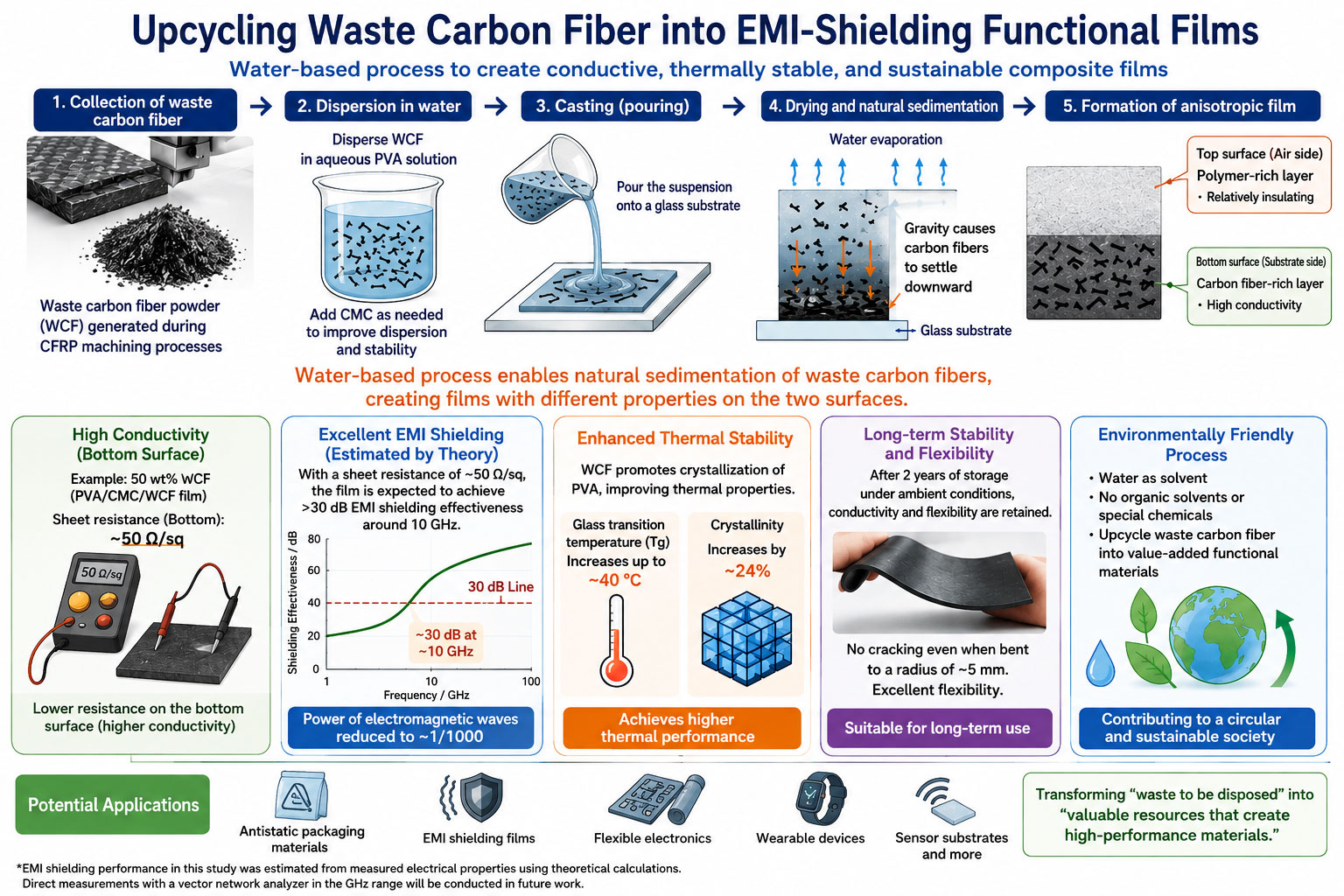
In this study, waste carbon fiber (WCF) powder generated during the machining of carbon fiber composite products was combined with the water-soluble polymers poly(vinyl alcohol) (PVA) and sodium carboxymethyl cellulose (CMC) to fabricate composite films using a water-based solution-casting process. This simple approach enables the production of conductive films without organic solvents or specialized chemical reagents, thereby reducing the environmental impact of the fabrication process.
Laser microscopy and micro-Raman spectroscopy revealed that the carbon fibers were not uniformly distributed throughout the films. Instead, during drying, the carbon fibers gradually settled toward the glass substrate under gravity, producing a concentration gradient across the film thickness. As a result, an anisotropic structure spontaneously formed: one surface consisted of a relatively polymer-rich, electrically resistive layer, whereas the opposite surface contained a carbon-fiber-rich, highly conductive layer.
In particular, for the PVA/CMC/WCF composite film containing 50 wt% WCF, the sheet resistance of the carbon-fiber-rich back surface decreased to approximately 50 Ω/sq. Based on this experimentally measured value, the electrical conductivity was calculated and the electromagnetic interference (EMI) shielding performance was theoretically estimated using a thin-film shielding model. The results predicted an EMI shielding effectiveness exceeding 30 dB at around 10 GHz.
The waste carbon fibers provided an additional benefit beyond electrical conductivity. They also acted as heterogeneous nucleating agents that promoted the crystallization of PVA. Differential scanning calorimetry showed that the glass transition temperature increased by up to approximately 40 °C, while crystallinity increased by approximately 24%, demonstrating that the incorporation of WCF also contributed to improved thermal stability.
The long-term stability of the films was also evaluated after storage under ambient laboratory conditions for two years. The films largely retained their electrical conductivity and remained flexible, showing no damage even when bent to a radius of approximately 5 mm. These results demonstrate the potential of the composite films to retain their functional properties over extended periods.
A key feature of this study is the use of carbon fiber powder that would otherwise be discarded, rather than expensive conductive fillers such as graphene or carbon nanotubes. Moreover, the study turns a phenomenon that is normally considered undesirable in composite fabrication—particle sedimentation—into an advantage. By utilizing the natural settling of carbon fibers during film formation, a film with different functional properties on its two surfaces can be produced without additional coating or lamination processes.
Future work will focus on direct measurements of EMI shielding performance in the GHz frequency range using a vector network analyzer, as well as detailed evaluation of cyclic bending durability, tensile properties, and humidity dependence. Potential applications include antistatic packaging, EMI-shielding films, and flexible electronics. Importantly, the EMI shielding performance reported in this study is a theoretical prediction based on experimentally measured electrical conductivity, rather than a direct experimental measurement of EMI shielding effectiveness.
【Publication】
"Upcycling waste carbon fiber into anisotropic, conductive PVA/CMC films with enhanced thermal stability and EMI shielding", Weizhong Zhang, Linmei Zhang, Kunkun Fu, Kazushi Yamada*, Surfaces and Interfaces, 76 (2025) 107967.
DOI: 10.1016/j.surfin.2025.107967 (See Elsevier Website.)