
Press Release
Published October 1, 2025
UV-Shielding Alginate Films by Simply “Replicating” Cicada-Wing Nanostructures
Introducing New Optical Functionality into Naturally Derived Alginate Films
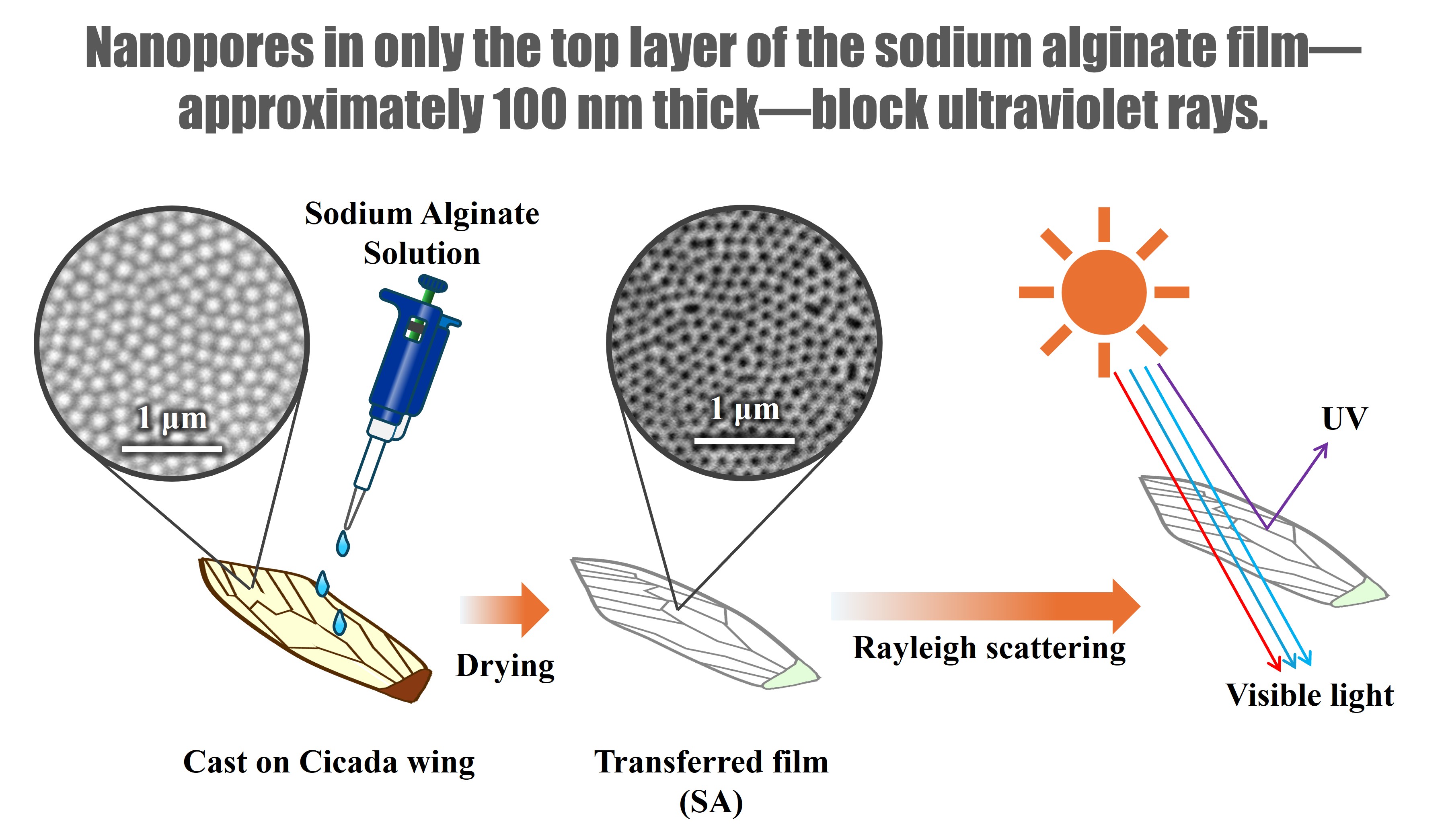
The transparent wings of cicadas possess highly ordered nanostructures on their surfaces that are invisible to the naked eye. In this study, we developed a functional ultraviolet (UV)-shielding film by directly replicating these natural nanostructures onto the surface of a sodium alginate film, a naturally derived polymer obtained from seaweed. Unlike conventional UV-shielding materials that rely on UV absorbers or inorganic nanoparticles, a key feature of our approach is that UV light is attenuated by scattering from the surface nanostructure itself.
Using Cicada Wings as Natural “Nanomolds”
Growing concerns over plastic pollution and microplastics have created an urgent need for renewable and biodegradable alternatives to petroleum-based plastics. One promising candidate is alginate, a natural polysaccharide derived primarily from brown seaweed. Rather than adding new chemical substances to provide functionality, we explored whether the sophisticated micro- and nanostructures already present in nature could be used to impart new functions to natural polymer materials. Scanning electron microscopy revealed that the cicada-wing surface is covered with regularly arranged nanoscale protrusions approximately 100 nm in size. An aqueous sodium alginate solution was directly deposited onto the cicada wing and dried. When the resulting film was peeled from the wing, the surface nanostructure was inversely replicated, producing a uniformly nanopatterned alginate surface. In other words, Cicada wing → Natural nanomold → Alginate film provides a remarkably simple route for fabricating naturally derived polymer films with nanoscale surface structures.
Scattering UV Light through Surface Nanostructures
A conventional smooth alginate film is highly transparent, transmitting more than 90% of visible light. In contrast, films carrying the replicated cicada-wing nanostructure showed reduced light transmittance, with a particularly pronounced reduction in the shorter-wavelength UV region. This behavior is primarily attributed to Rayleigh scattering caused by the nanoscale surface structures. Because Rayleigh scattering becomes stronger at shorter wavelengths, UV light is scattered more effectively than visible light. Calcium-ion crosslinking further altered the surface morphology, producing larger surface features that introduced an additional contribution from Mie scattering. Under the condition showing the strongest effect, the transmitted light at 254 nm was attenuated by approximately 60% compared with a smooth alginate control film. Thus, rather than “absorbing UV light with additives,” this study demonstrates a different strategy: “scattering UV light with nanostructures.” This concept enables optical functionality to be introduced into natural polymer films through surface architecture alone.
Controlling Thermal and Surface Properties
Calcium-ion crosslinking affected not only UV-shielding performance but also the thermal properties of the films. Differential scanning calorimetry (DSC) indicated that crosslinking restricted the molecular mobility of the alginate chains and improved the thermal stability of the films. Replication of the nanostructure also altered the wettability of the film surface. Further changes in surface morphology induced by calcium crosslinking produced films with enhanced hydrophilicity. These results demonstrate that controlling surface micro- and nanostructures may provide a means of tuning multiple material functions, including optical properties, thermal behavior, and wettability. The fabricated films were also stored for one year under ambient laboratory conditions. After storage, both their UV–Vis transmission characteristics and surface nanostructures were largely retained, demonstrating the long-term stability of the replicated structures and their optical properties.
Toward Sustainable Materials Designed Using Structures Found in Nature
The significance of this study extends beyond the simple use of an environmentally friendly natural polymer. The central concept is to directly transfer sophisticated nanostructures already created by nature onto material surfaces and use the structures themselves to generate functionality. In the future, this concept could be extended beyond alginate to cellulose and other naturally derived polymers. The use of different natural surface structures may also enable the development of materials with a variety of functions, including UV shielding, controlled wettability, optical reflection, and structural coloration. Potential applications include environmentally friendly packaging materials, functional coatings, and biomedical materials, providing a new route toward sustainable functional polymer films.
【Publication】
"Sustainable UV-shielding sodium alginate films via direct nanostructure replication from cicada wings", Linmei Zhang, Haruhiro Ino, Shinjiro Machida, Kunkun Fu, Kazushi Yamada, Colloids and Surfaces A: Physicochemical and Engineering Aspects, 728 (2026) 138501.
DOI: 10.1016/j.colsurfa.2025.138501 (See Elsevier Website.)